
Non IT Payroll Solutions

Running payroll is one of those things that sounds straightforward until you’re actually doing it. For businesses outside the technology sector — hotels, hospitals, retail chains, logistics companies, manufacturing plants — the challenge goes deeper than just calculating salaries. You’re managing shift workers, contract staff, seasonal hires, variable allowances, compliance across multiple locations, and a workforce that barely sits at a desk.

That’s exactly where non IT payroll solutions come in. These aren’t just software tools repurposed for different industries. They’re payroll ecosystems designed from the ground up for how non-tech businesses actually work.

What Makes Non IT Payroll Different?

Most mainstream payroll software was built with office-based, salaried employees in mind. Punch a number in, run a calculation, done. But if you manage a 500-person hotel, a pharmaceutical distribution team, or a construction crew across three sites — that model falls apart quickly.

Non IT payroll solutions are engineered to handle the actual complexity of physical, field, and shift-based workforces. Think overtime tracking that actually understands hospitality shift patterns. Statutory compliance modules built for healthcare regulatory requirements. Wage processing that can handle piecework in a garment factory alongside salaried management in the same pay cycle.

Core Features That Actually Matter

There’s no shortage of payroll platforms on the market. The difference between a generic solution and a genuinely useful one comes down to a handful of capabilities that non-IT businesses can’t afford to be without.

Multi-location and multi-entity payroll

A retail brand with stores across five countries. A logistics company with depots in six cities. A hospital group with multiple specialist divisions. Each entity may have different pay structures, local tax obligations, and compliance rules.

Shift, attendance, and overtime management

For industries like hospitality, aviation, and manufacturing, pay isn't just about base salary. It's about accurately capturing shift differentials, night allowances, overtime eligibility, and attendance patterns. Systems that integrate directly with biometric attendance.

Statutory and regulatory compliance

Every country, every industry has its own rulebook. Healthcare workers have specific benefits entitlements. Construction companies deal with contract-based labour laws. Export businesses navigate PF, ESI, gratuity, and international transfer regulations simultaneously.

Flexible payroll structures

Not every employee in a non-IT company has the same pay structure. A fashion retailer might have salaried store managers, hourly sales associates, commission-based buyers, and freelance designers — all within the same organisation.

Core Features That Actually Matter

There’s no shortage of payroll platforms on the market. The difference between a generic solution and a genuinely useful one comes down to a handful of capabilities that non-IT businesses can’t afford to be without.

Multi-location and multi-entity payroll

A retail brand with stores across five countries. A logistics company with depots in six cities. A hospital group with multiple specialist divisions. Each entity may have different pay structures, local tax obligations, and compliance rules.

Shift, attendance, and overtime management

For industries like hospitality, aviation, and manufacturing, pay isn't just about base salary. It's about accurately capturing shift differentials, night allowances, overtime eligibility, and attendance patterns. Systems that integrate directly with biometric attendance.

Statutory and regulatory compliance

Every country, every industry has its own rulebook. Healthcare workers have specific benefits entitlements. Construction companies deal with contract-based labour laws. Export businesses navigate PF, ESI, gratuity, and international transfer regulations simultaneously.

Flexible payroll structures

Not every employee in a non-IT company has the same pay structure. A fashion retailer might have salaried store managers, hourly sales associates, commission-based buyers, and freelance designers — all within the same organisation.

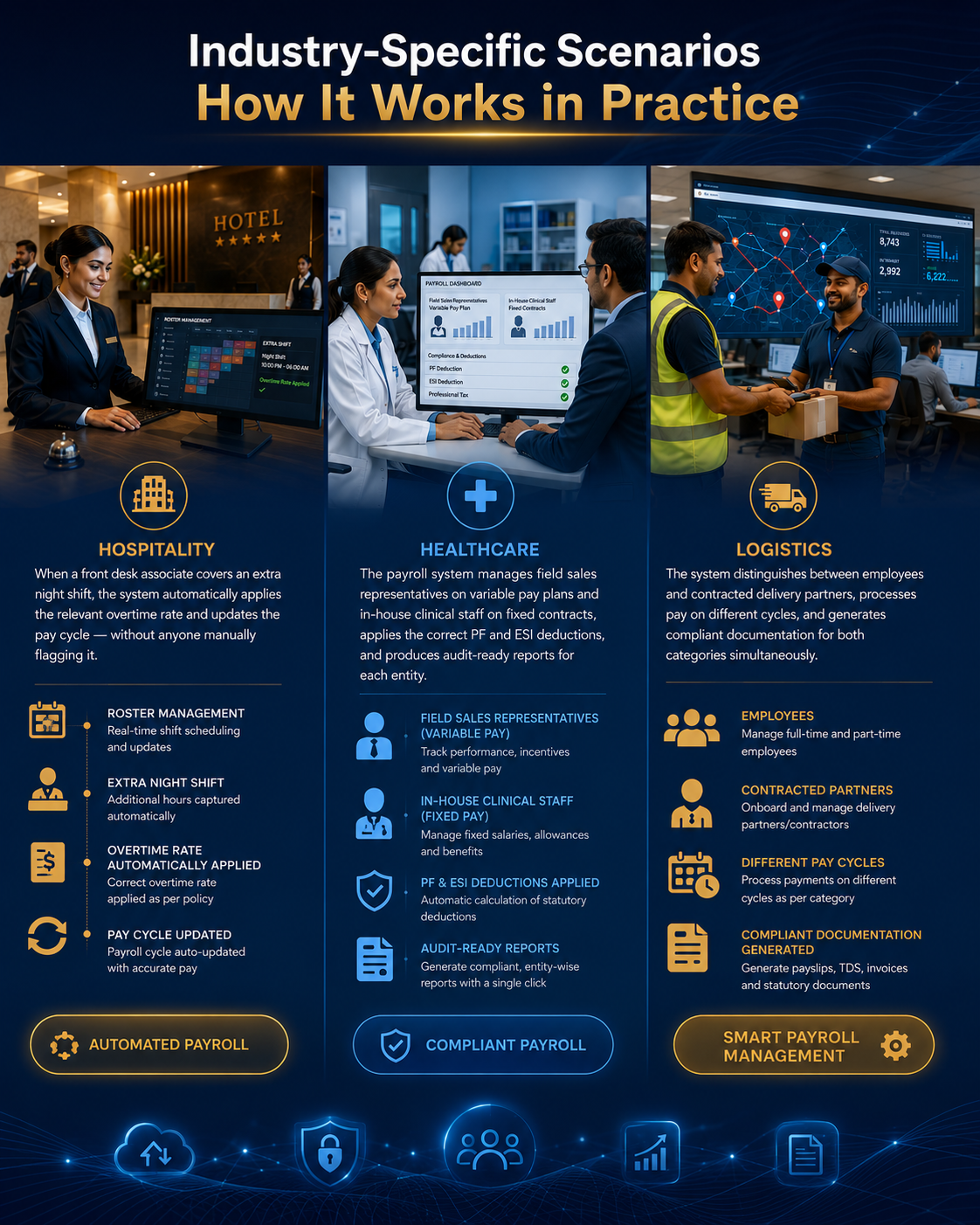
Industry-Specific Scenarios: How It Works in Practice

In hospitality: A mid-size hotel chain running 24/7 operations needs payroll that syncs with roster management. When a front desk associate covers an extra night shift, the system should automatically apply the relevant overtime rate and update the pay cycle — without anyone manually flagging it.

In healthcare: A pharmaceutical company distributing across multiple regions needs to track field sales representatives on variable pay plans, alongside in-house clinical staff on fixed contracts. The payroll system must manage both, apply the correct PF and ESI deductions, and produce audit-ready reports for each entity.

In logistics: A courier network with thousands of delivery partners — some employees, some contracted — needs a system that can distinguish between the two, process pay on different cycles, and generate compliant documentation for both categories simultaneously.

Frequently Asked Questions

Non IT payroll solutions are payroll management platforms designed specifically for industries outside the technology sector — such as hospitality, healthcare, logistics, retail, and manufacturing. They're built to handle the unique challenges of these sectors, including shift-based pay, variable allowances, multi-location compliance, and contract workforce management

Yes. Modern non IT payroll platforms are built for multi-entity management, meaning a single group that owns a hotel chain, a retail brand, and a logistics arm can run payroll for all three from one system — each with their own pay structures, compliance rules, and reporting requirements.

Good non IT payroll solutions come with built-in compliance engines for each country of operation. These include local tax calculations, statutory contribution requirements (such as PF, ESI, or social security), and labour law rules. The platform should update these automatically when regulations change, reducing the compliance burden on your HR and legal teams.

Absolutely. This is one of the key strengths of a purpose-built non IT payroll solution. It can manage salaried employees, hourly workers, commissioned staff, and contracted individuals within the same pay cycle — each with their own pay structure, deduction rules, and documentation requirements.